Everything You Need to Know About Crypto and Fiat: How Do They Differ?


Imagine trying to spend ₦1,000 note back to the 1600s, the market women would stare at you like you just arrived from the sky. If you showed them Bitcoin on your phone, they might even start calling the town elders for an emergency meeting. But if you tender cowries, you might just become the VIP of the entire village. This is how drastically money has changed over time.
From shells, to metals, to paper, to plastic cards, and now to currencies that don’t physically exist. Today, the world operates with two major forms — fiat, the traditional government-issued currency, and cryptocurrency, the digital alternative that is shaping the future of value exchange. Both qualify as money. Both can be used to pay for goods and services. But they function differently and influence the financial system in different ways.
If you’ve ever wondered why people trust cash while others swear by crypto, this breakdown gives you a clear and simple explanation.
Key Takeaways
- Fiat is government-issued currency backed by law, regulation, and national trust.
- Crypto is digital, decentralised money secured by blockchain technology.
- Fiat supply is unlimited; crypto supply often follows strict caps and coded rules.
- Fiat value depends on government stability; crypto value depends on scarcity, demand, and utility.
- Both forms of money continue to shape the global financial system in unique ways.
What Exactly Is Fiat?
Fiat is the money everyone already understands. It’s the cash in your wallet, the funds sitting in your bank app, and the currency used to pay bills, buy groceries, and settle debts. It has value because the government says it does, and people trust that declaration enough to use it daily. Unlike commodities such as gold or precious metals, fiat has no built-in value of its own. It only works because citizens and institutions accept it.
Governments also decide how much fiat should exist. They issue new notes, alter supply based on economic goals, and regulate how the currency moves through banks. While this flexibility helps countries manage economic growth, it also means fiat can lose value when too much is printed. Inflation is the most common example. Still, fiat remains the world’s primary medium of exchange because it is widely recognised, stable enough for everyday use, and backed by legal authority.
What Is Cryptocurrency?
Cryptocurrency is a modern form of money built entirely for the digital world. It relies on cryptography for security and uses blockchain technology to record transparent, tamper-proof transactions. No single government, bank, or central authority controls it. Instead, the system operates through decentralised networks and open-source code.
One of the unique characteristics of many cryptocurrencies is that their supply is fixed or strictly regulated by code. Bitcoin, for example, will never exceed 21 million units. This scarcity helps protect its value over time and prevents inflation caused by oversupply. Crypto also gains value from utility, adoption, market demand, and the strength of the underlying blockchain network. Because it is borderless and accessible to anyone with a smartphone, crypto has become a powerful option for global payments, remittances, wealth storage, and financial inclusion.
Crypto vs Fiat: The Major Differences
1. Issuance & Control
Fiat is controlled by governments and central banks. Crypto is controlled by decentralised networks and coded rules. One is influenced by policy; the other is guided by technology.
2. Supply
Fiat can be printed endlessly based on government decisions. Crypto supply is limited or algorithmically managed, which helps maintain scarcity.
3. Value
Fiat’s value depends on trust in the government and national stability. Crypto’s value depends on adoption, utility, scarcity, and market demand.
4. Transactions
Fiat transactions rely on banks and intermediaries, which can involve delays and restrictions. Crypto transactions are peer-to-peer, often faster, and accessible worldwide.
5. Security
Fiat relies on regulations and law enforcement. Crypto relies on blockchain transparency, cryptographic protection, and decentralised verification.
Why Crypto and Fiat Still Matter
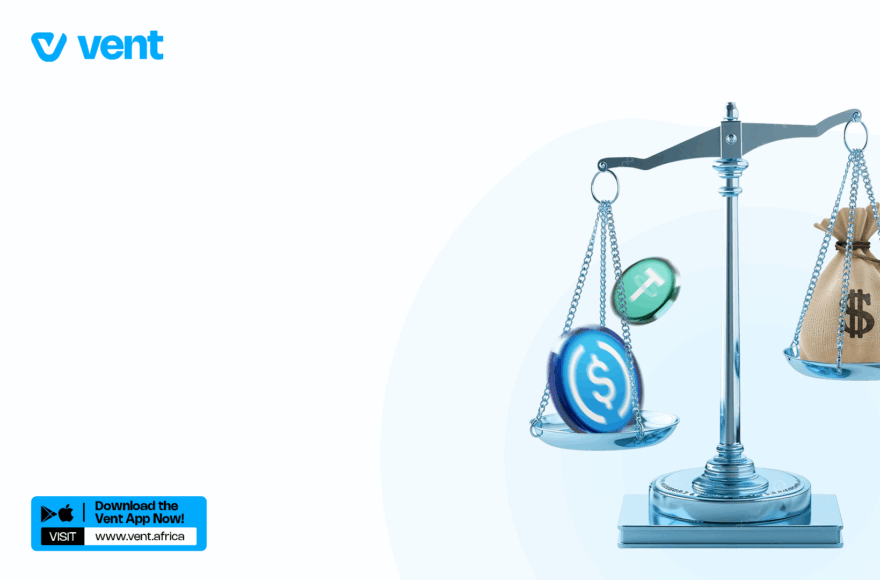
Crypto and fiat are not enemies; they serve different purposes. Fiat remains essential for everyday commerce, government operations, and stable pricing systems. Crypto, on the other hand, introduces speed, digital efficiency, global access, and innovative ways to transfer and store value. Both will continue to coexist as financial systems evolve, with crypto steadily taking on more responsibilities in global payments, remittances, and digital finance.
Final Thoughts
Crypto adoption continues to grow, and Vent is committed to making the journey smooth, fast, and secure. Our platform gives you an effortless way to convert crypto to cash in seconds, without complications or delays.
If you want a simple and reliable bridge between digital money and traditional currency, Vent Africa is your best option. Sign up today and enjoy instant withdrawals whenever you need them.
Download the Vent app on Play Store or App Store to get started.